Daughters of Tomorrow's Social Mobility Research Programme

An infographic poster and comprehensive data analysis for Daughters of Tomorrow's report on what stability means for 98 lower-income women in Singapore.

Daughters of Tomorrow
Daughters of Tomorrow's Social Mobility Research Programme

Partner:

Daughters of Tomorrow

Project type:

Infographic

Scope:

Data visualisation
Design
Social media
Research
See it live
The lives of lowered-income women in Singapore are shaped by constant ups and downs, by caregiving demands, health shocks, and workplaces. Daughters of Tomorrow (DOT) spent a year journeying with them, offering two separate interventions, coaching or income support, and tracking its impact across 6 key areas.
Daughters of Tomorrow's Social Mobility Research Programme

About the project

A multi-part data story produced in collaboration with Daughters of Tomorrow (DOT) on their Social Mobility Research Programme. The yearlong study followed 98 lower-income women in Singapore, comparing two forms of support: coaching and unconditional cash transfers. It tracked how each shaped the women's lives across six dimensions of poverty, scored through the Family Stoplight self-assessment tool. Kontinentalist worked as the data storyteller, handling data cleaning and analysis, infographic and data visualisation design, and some narrative development.

The challenge

Visualizing research and data with intersectionality in mind
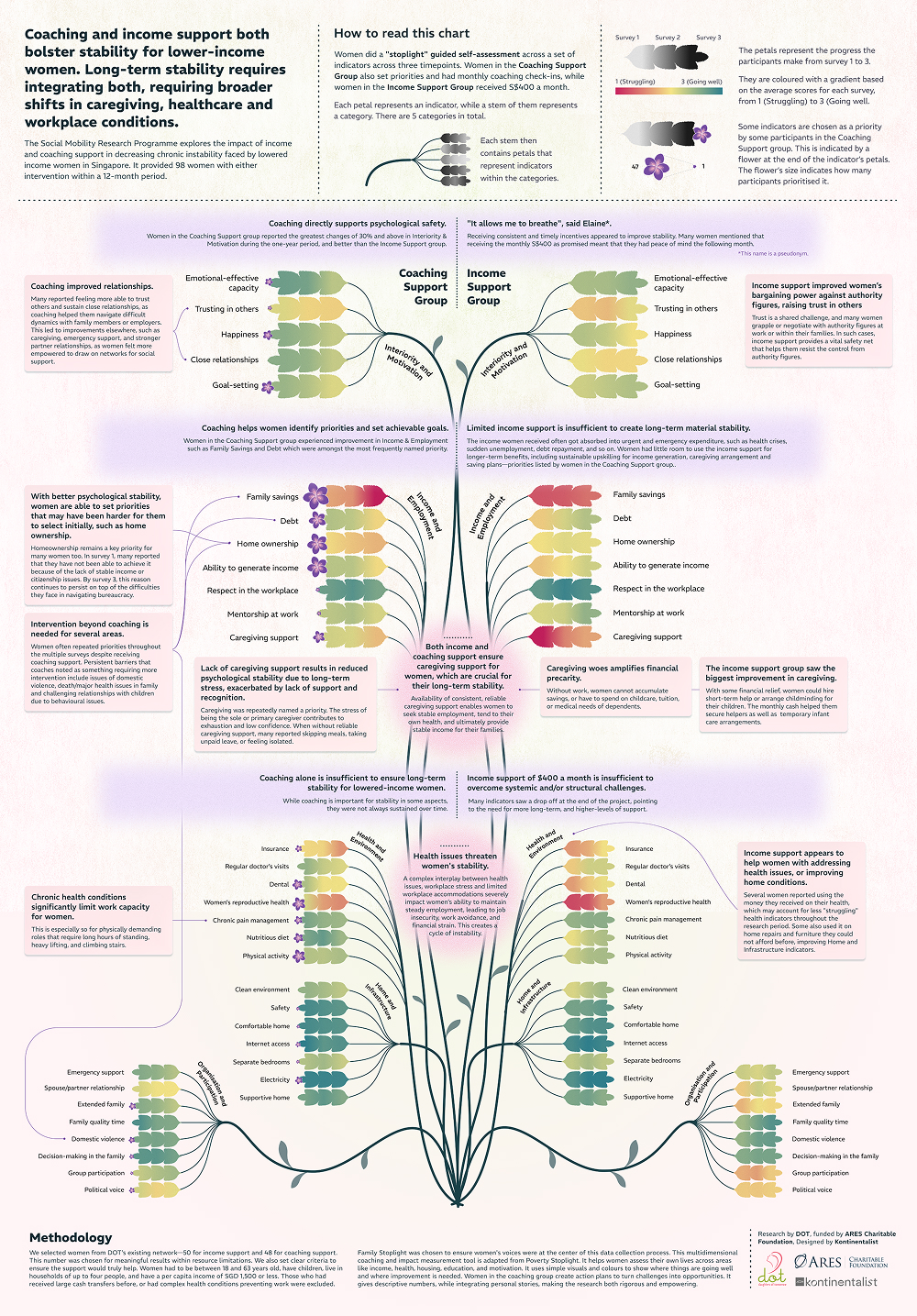
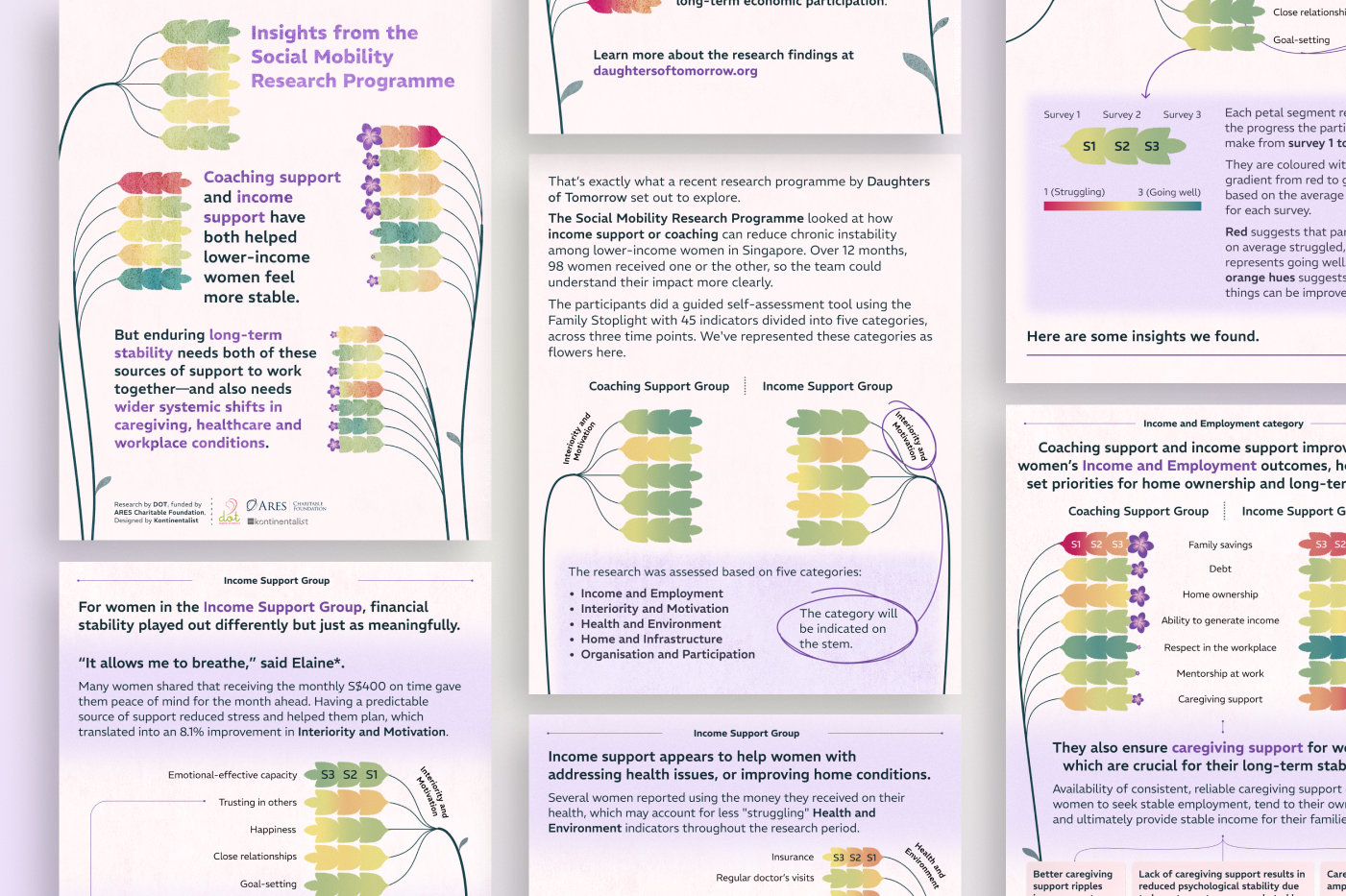
The study is mixed-methods and longitudinal, drawing on 45 indicators across six dimensions of poverty, with quantitative scoring alongside qualitative observations from coaches and surveyors. The Family Stoplight tool produces colour-coded results that can be aggregated into trends and averages, but it was important to represent this without flattening women’s experiences and specific challenges. Our challenge was to design and create a communication that will bring together data and human elements in quotes, and ensuring the rigour of the research was something the public can engage with.
Daughters of Tomorrow's Social Mobility Research Programme

Working with sensitive material with care

The data on this project came from real women navigating real precarity. Poverty data can flatten the people behind it into statistics, especially when the goal is to communicate scale and pattern. The work needed to honour the participants throughout, by foregrounding their agency, choices, and reflections rather than reducing them to data points. DOT's own research ethic of dignity and participation set the tone for how we approached every visualisation.

Our creative solution

We supported this story with deep data cleaning and analysis, and made qualitative readings of the stoplight to fully understand the data and numbers in context. We prepared several varied data visualization decks to support the unfolding of the data narrative to the public, while retaining granularity of the numbers. Interactive visualisations carried the numerical findings, including changes across the six dimensions, comparisons between the two intervention groups, and individual scorecards over time.

A key output of this project was in designing an infographic that will communicate the top insights all at once, read cohesively as the totality of women’s experiences rather than singular compartments or dimensions. It was also crucial to not compare the coaching or income supplement in either/or dimensions, but how they can be supplementary and elicit different results. The infographic paired quotes and reflections alongside numbers visualised through a floral metaphor to give texture to the data. 

To handle the sensitive material with care, we kept the women's agency and voices visible throughout, and added them to our key notes and findings. We worked closely with DOT on language and framing, taking cues from their research ethic of participation and dignity.

Our partners

Daughters Of Tomorrow is a Singapore-based charity that complements and supports existing training and workforce-related agencies by connecting volunteers and community resources to enable each woman on an individual level.

You’ve done the work. Now let us make it exceptional.

Contact us